Photo: Per / CC BY-SA 2.0
New England · Winter 2026–27
What birds come to feeders in winter, and what to feed them
When insects and wild seed run short, a simple station of black-oil sunflower, suet, and white millet will feed almost every regular winter visitor in New England. Here is who to expect, what to pour, and what this winter’s finch forecast actually says.
Winter is the season when a feeder earns its hook. Most songbirds that stay in the Northeast shift from insects to seeds and fruit, which is why a backyard that felt quiet in August can feel busy in January. You do not need a rare bird to make that worthwhile. In Project FeederWatch’s 2024–25 winter counts, the same core group showed up at more than 80 percent of feeder sites in every Northeast state: chickadees, Dark-eyed Juncos, Northern Cardinals, Blue Jays, Downy Woodpeckers, White-breasted Nuthatches, and Tufted Titmice.
Those percentages measure how many participating feeders reported the species at least once between November and April, not how many birds live in your town. A Connecticut yard and a northern Maine yard share that core list and then diverge: House Finches and Red-bellied Woodpeckers are much more reliable in southern New England than in Maine or Vermont. For a state-level calendar, see Backyard birds of Connecticut.
The winter regulars
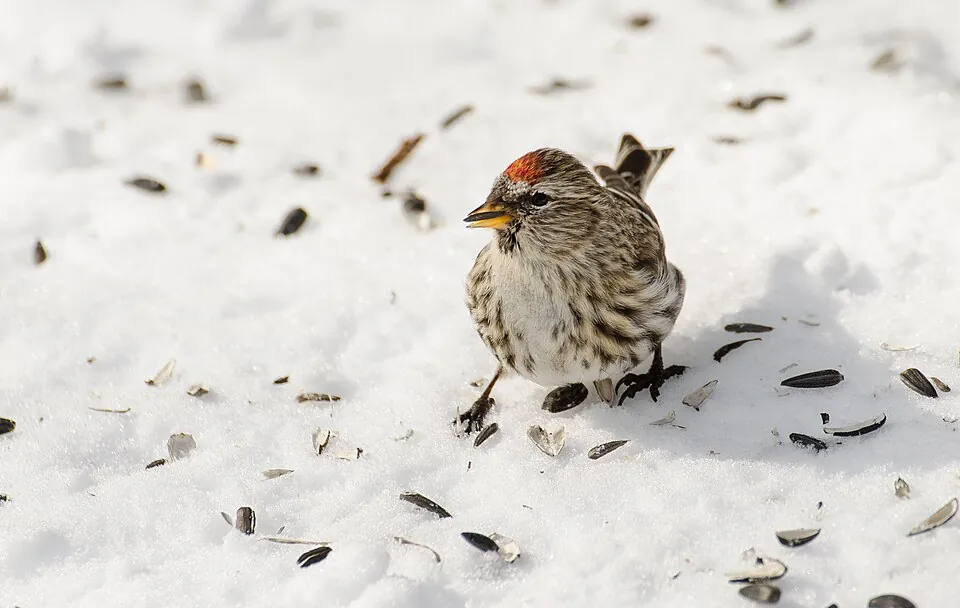
A redpoll in snow, the kind of winter finch people hope for at a tray of seed. Photo: Per from Kaministiquia, Canada. CC BY-SA 2.0. Image credits.
Start with the birds you can reasonably plan for, not the ones that make headlines.
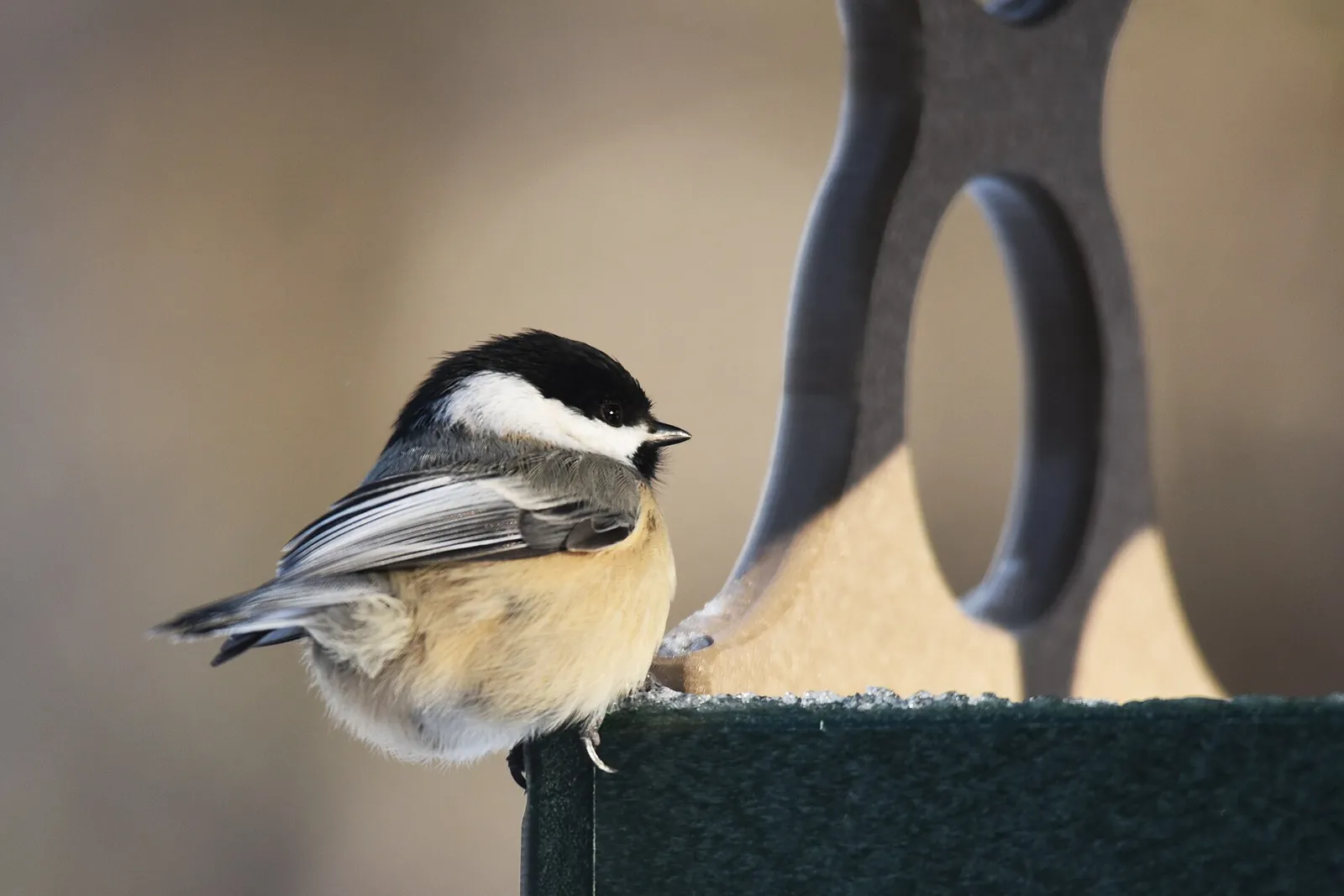
Black-capped Chickadee, Tufted Titmouse, and White-breasted Nuthatch are the hanging-feeder crew. They take sunflower, peanuts, and suet, often darting in, grabbing one seed, and leaving to eat it elsewhere. Chickadees are the year-round voice of a New England yard; a nuthatch is the one walking headfirst down the trunk.
Downy, Hairy, and Red-bellied Woodpeckers come to suet first, then peanuts and sunflower. The Downy is the small one with a short bill; the Hairy looks similar but is larger, with a bill as long as its head. Red-bellied Woodpeckers are now routine in southern New England — 89.05 percent of Connecticut FeederWatch sites reported them in 2024–25, against just over half of Maine sites.
Northern Cardinal and Blue Jay are the color. Cardinals work hopper and platform feeders for black-oil sunflower and safflower. Jays take peanuts, sunflower, and corn, and they can empty a tray faster than seems fair. Some jays stay all winter; some move.
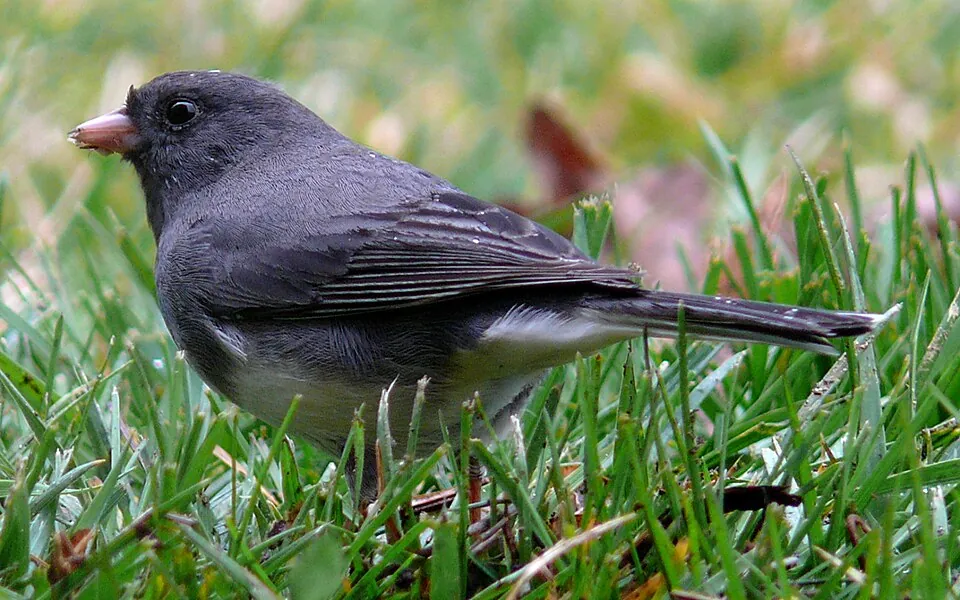
Dark-eyed Junco and White-throated Sparrow are the ground crew. Juncos are the slate-gray winter arrivals that flash white outer tail feathers when they flush. They want millet and sunflower hearts on a low tray or on the ground, not a hanging tube designed for titmice. White-throated Sparrows are the ones singing a thin Old Sam Peabody from a hedge even on a raw December day. Both are winter birds at most New England feeders, not summer fixtures.
Mourning Doves, House Finches, and American Goldfinches fill out the list. Doves feed on the ground or on broad platforms and take millet, cracked corn, and sunflower. House Finches are nearly year-round at southern New England seed feeders. Goldfinches stay through the winter in dull olive plumage and turn bright again in spring; nyjer and hulled sunflower keep them around.
American Tree Sparrows and Fox Sparrows are worth watching for but are not everyday birds at every station. Tree Sparrows are more of a January visitor in parts of the region; Fox Sparrows often show on the way through in late fall and again in March. Carolina Wrens, once a southern bird, now winter commonly in Connecticut and coastal southern New England and will use suet and mealworms when the cold gets serious.
What to feed them
The Cornell Lab of Ornithology has said the same thing for years, and it still holds: black-oil sunflower attracts the greatest number of species. The seeds have a high meat-to-shell ratio, a lot of fat, and a thin shell that small birds can crack. Striped sunflower works too, but the shell is thicker. Hulled sunflower (hearts or chips) removes the mess and is easier for smaller bills, though it spoils faster in wet weather.
Build the rest of the station around a few specialty foods, each in its own feeder, which is also Audubon’s advice:
- Suet for woodpeckers, nuthatches, chickadees, titmice, and wrens. Audubon and Mass Audubon both treat suet as a cold-weather food. In heat it can turn rancid, and dripping fat can damage the waterproofing on feathers. In a New England winter that problem mostly waits until spring.
- Nyjer (often labeled thistle, though it is not a North American thistle) for goldfinches, and for siskins or redpolls if they appear. Use a dedicated nyjer tube or sock. Cornell notes that the seed is small, expensive, and wasted in a mix; it is heat-treated before import so it should not sprout.
- White proso millet on a platform or scattered in small amounts for juncos, sparrows, and doves. Put out only what will be eaten in a day, Mass Audubon says, so it does not rot.
- Peanuts, unsalted and unshelled or in a mesh peanut feeder, for jays, woodpeckers, nuthatches, chickadees, and titmice. Audubon’s winter-foods list calls for dry-roasted, unsalted peanuts.
- Safflower if cardinals are the goal and you are trying to discourage some squirrels and starlings. Cornell’s experience is that most birds still prefer sunflower when they have a choice.
Cheap mixed bags are often padded with milo, wheat, or other seeds that many eastern birds toss aside. Cornell and Mass Audubon both warn that birds will kick the filler to the ground to reach the sunflower, which wastes money and leaves a mat of rotting seed. If you want a mix, make a simple one: Cornell has suggested combining black-oil sunflower with white proso millet and cracked corn, and storing it in a tight metal container. The full seed-to-bird chart explains which foods draw which birds. For currently sold bags and cakes, see the best bird seed for winter feeders guide.
Skip bread, crackers, salted snacks, and anything processed. Mass Audubon is blunt: those foods fill a bird up without offering real nutrition. Never add glycerin to a bird bath to keep it from freezing.
This winter’s finches, without the hype
Every few years, social posts and retailer blogs talk as if New England is about to be buried in redpolls and Evening Grosbeaks. Sometimes that is true. This winter, the official forecast is more careful. The short version is below; the full plain-English walkthrough, with a link to the official page, is in our 2026–27 Winter Finch Forecast guide.
The Finch Research Network’s Winter Finch Forecast for 2026–27, published by Tyler Hoar in late September, says seed crops are good in the East — including eastern white pine, northern white cedar, and a fair-to-good spruce crop — and poor in much of the central boreal. Finches should move into Eastern Canada, the Great Lakes, and the northeastern United States, but they will likely spend more time in the woods than at feeders because the northeastern conifer crop is plentiful. The forecast does not expect big irruptions into the southeastern states.
The species notes, in brief:
- Redpolls: not a big flight year. Good birch crops in parts of Quebec and the Maritimes should hold most birds north. A small or modest showing in northeastern border areas would not be a shock, but it is not the headline.
- Evening Grosbeaks: small to medium flocks should be findable in the better northeastern haunts, and a small movement south into places such as southern New York, Pennsylvania, and Massachusetts is possible. They want black-oil sunflower on a platform.
- Pine Siskins and Purple Finches: present in the Northeast, but often in the forest, feeding on cedar, hemlock, spruce, and white pine, rather than in a nyjer sock. If they do come to the yard, offer nyjer and black-oil sunflower.
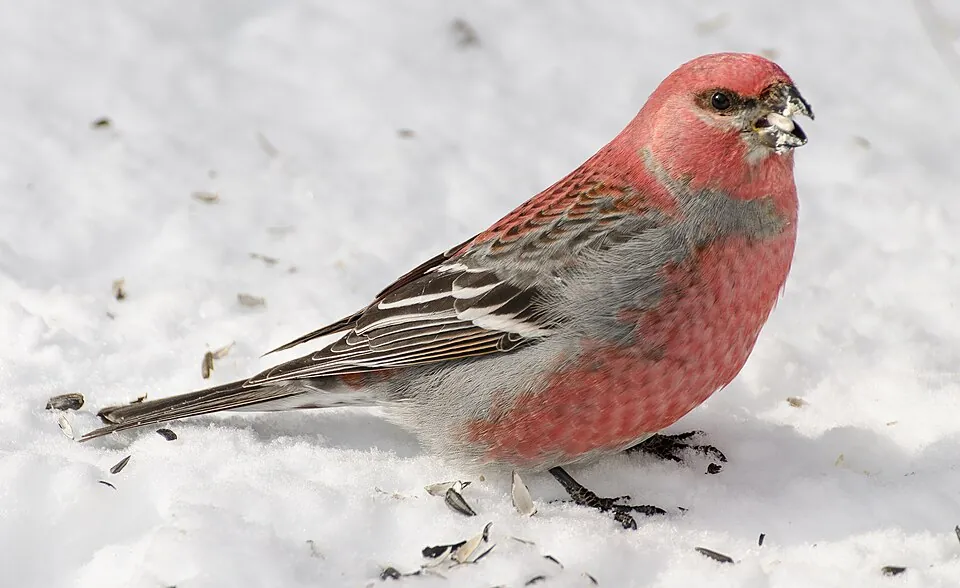
- Pine Grosbeaks: not much of a flight expected, after last year’s modest irruption, because the mountain-ash crop looks strong farther north.
- Crossbills: Red Crossbills, including an incoming Type 2 irruption from the West, and some White-winged Crossbills should be in northeastern forests where the cone crop is good. That is a walk in the woods, not a feeder event.
If you want a finch, put out nyjer and sunflower, then go look in pines and hemlocks. Do not buy a new gadget on the promise of a once-in-a-decade irruption. A feeder camera is still a reasonable winter luxury because the regulars will be there either way. For who is already at New England feeders this month, see the November feeder report.
Water, placement, and safety
Open water can be as valuable as seed when everything else is frozen. Mass Audubon recommends a bath no deeper than about two inches for small birds, or a deeper basin with stones for perches, cleaned often, and kept open with an electric heater made for bird baths. Frequent refilling can also work. Glycerin and other antifreeze additives are unsafe.
Place feeders where birds can reach cover — a shrub or tree line — without handing the station to squirrels or cats. Mass Audubon suggests 12 to 15 feet from launch points if you are trying to keep squirrels from leaping onto the feeder, and it notes that a successful baffle is one a squirrel cannot cling to, climb, or chew through. Cats are a different problem: keep them indoors if you can, and do not place a feeder so that it turns the hedge into an ambush.
Windows kill a lot of birds. If a feeder is close enough that a startled bird can hit glass, move it closer still (so a bird cannot get up speed) or much farther away, and use serious window markings, not a single decal.
In parts of central and western Massachusetts, and in other New England towns with black bears, Mass Audubon recommends taking feeders down from March through November, and anytime you see winter bear activity. If you are unsure of local bear advice, ask your state wildlife agency. Project FeederWatch also advises against feeding in bear country except when bears are hibernating.
Keep the station clean
A busy winter feeder can spread disease. House Finch eye disease (Mycoplasma conjunctivitis) is the example most people know, but salmonella and other pathogens travel through droppings too. Project FeederWatch and Mass Audubon both recommend regular cleaning. Mass Audubon’s rule of thumb is every two weeks, with one part bleach to nine parts water, then a thorough rinse and dry before you refill. If sick birds appear, take the feeders down for about two weeks, disinfect them, and clean up hulls and uneaten seed underneath.
Store seed in a cool, dry place, ideally in a metal can with a tight lid so rodents cannot chew in. Wet seed in a tube is wasted seed, and wasted seed becomes a health problem.
You do not have to keep the buffet running every hour of the winter. Mass Audubon notes that studies have found most birds get only about a quarter of their food from feeders, and that migration is not canceled by a full hopper. If you travel, birds will look elsewhere. If you start late, they will still find you.
A simple New England winter setup
- One tube or hopper of black-oil sunflower.
- One suet cage, refreshed before the cake crumbles into a mess.
- One nyjer feeder if you want goldfinches, and a chance at siskins or redpolls.
- One low tray of white millet for juncos and sparrows, filled modestly.
- A pole, a baffle, and a source of unfrozen water.
That station will not photograph as well as a four-camera feeder, but it will feed the birds that actually spend the winter here. If you later add a camera, you will already know who you are looking at. When you are ready to buy the seed itself, start with the winter bird-seed buying guide.
Sources
- Project FeederWatch, Cornell Lab of Ornithology, Top 25 Feeder Birds, 2024–25, including the Northeast regional list and state figures compiled from those published lists.
- Cornell Lab of Ornithology, Feeding Birds, and the Lab’s seed-preference materials on black-oil sunflower, nyjer, millet, safflower, and suet.
- National Audubon Society, 11 Tips for Feeding Backyard Birds and Top 10 Foods for Winter Bird Feeding.
- Mass Audubon, Bird Feeding Best Practices.
- Tyler Hoar, Finch Research Network, Winter Finch Forecast 2026–2027 (posted September 2026).